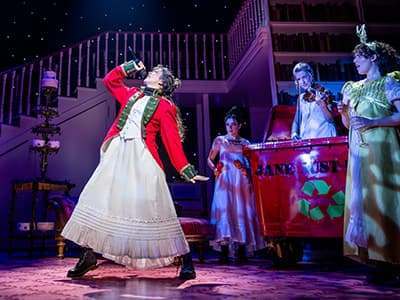
(If the kids are playing up and you’re not averse to the Victorian adage of ‘children should be seen and not heard', you can always relate the tale of the midday crone stealing away overly vocal kiddies. Or take them along to the next performance.)
The centrepiece of the suite of performances was Ernest Bloch’s Schelomo, one of his most notable works. Luckily for the rest of us, Bloch escaped the family clock business, vowing, as the story goes, from the tender age of 10, to become a composer. He can be considered a Jewish composer, in more ways than one: not just by dint of his birthright, but by his musical preoccupations; his themes, while not always directly referencing Hebraic sources, are nonetheless infused with those flavours. There are a couple of apocryphal stories that pertain to how he came to write the piece, which would easily flesh out an episode of Classic Albums, or something, but the real news, on the night, was the appearance by Texan violoncello virtuoso, Ralph Kirshbaum, who graced the stage for the full 20-odd minute length. Kirshbaum is, clearly, a passionate player and it’s this, to the untrained eye and ear, at least, that makes all the difference. Sure, it makes for an entertaining visual spectacle, watching his almost hyperventilated gestures, but it’s more than palpable in the performance; on a very distinguished ’cello, to boot. One can, literally, hear the conviction: not only Kirshbaum’s belief in the music, but Bloch’s; it’s almost as if RK is channelling the intentions of the rather serious young composer. It was a masterful and delightfully idiosyncratic rendition, which gathered optimal energy from the considerable collective force of the SSO. In case your Hebrew’s a little lacking, Schelomo, of course, translates as Solomon, as in the virile king; (biblically, he had as many as 700 wives and 300 concubines).
By the way, if you go out of yours to give this ‘Blochbuster’ a listen (which you can, 7pm, this coming Tuesday evening, April 14, via 92.9 ABC Classic FM, don’t expect the classic(al) big finish: to quote Katherine Kemp, ‘it dies, at the end, lonely in its grief’.
Last, but, by no means, least, we heard the eponymous Brahms’ (so-called) ‘5th’; so called, because, ’though, at root, the Brahms’ Piano Quartet in G Minor (Opus 25), this is Arnold Scoenberg’s orchestral take. Today, we call it plagiarism; then, it was homage. I jest. Schoenberg took the time and trouble purely and simply because he liked the piece and felt it criminally underexposed; when played, he found it played badly. This was his fix.
’Twas a good move to borrow Paul Daniel from his soon-to-be principal conductorship of the WASO. Many’s the smile I caught from other audience-members, clearly delighted by Schoenberg’s and the orchestra’s dramatics, but, above all, by Daniel’s almost Chaplinesque ‘batonic’ eccentricities. Schoenberg isn’t everyone’s cup o’ soup. Even he knew: ‘if people speak of me, they connect me with horror’. Brahms, by contrast, has put many of us to sleep; in a good way. The coming together might seem unlikely, a little like a collaboration between Henry Rollins & Britney (well, you know), but closer examination shows it to be almost inevitable: Schoenberg’s first composition teacher was a JB charge and his classes amply reflected this bias; AS performed Brahms’ chamber music, as a string-player; Schoenberg even wrote an essay in which he declaimed his profound love for the older composer (in the best musical sense). He has brought this, in spades, to his orchestration of JB’s piano quartet and, once again, the SSO has, through its musicality, professionalism and rigour, but, more than anything, vigour, made this very real and, in the final movement, electrifying.
Sydney Symphony Orchestra
Brahms’ ‘Fifth Symphony’
Venue: Sydney Opera House
Dates/Times: Thu 10 Apr 1.30pm; Fri 11 Apr 8pm; Sat 12 Apr 2pm; Mon 14 Apr 7pm
Bookings: Sydney Symphony Box Office: 02 8215 4600 or